Data Analyst Roadmap
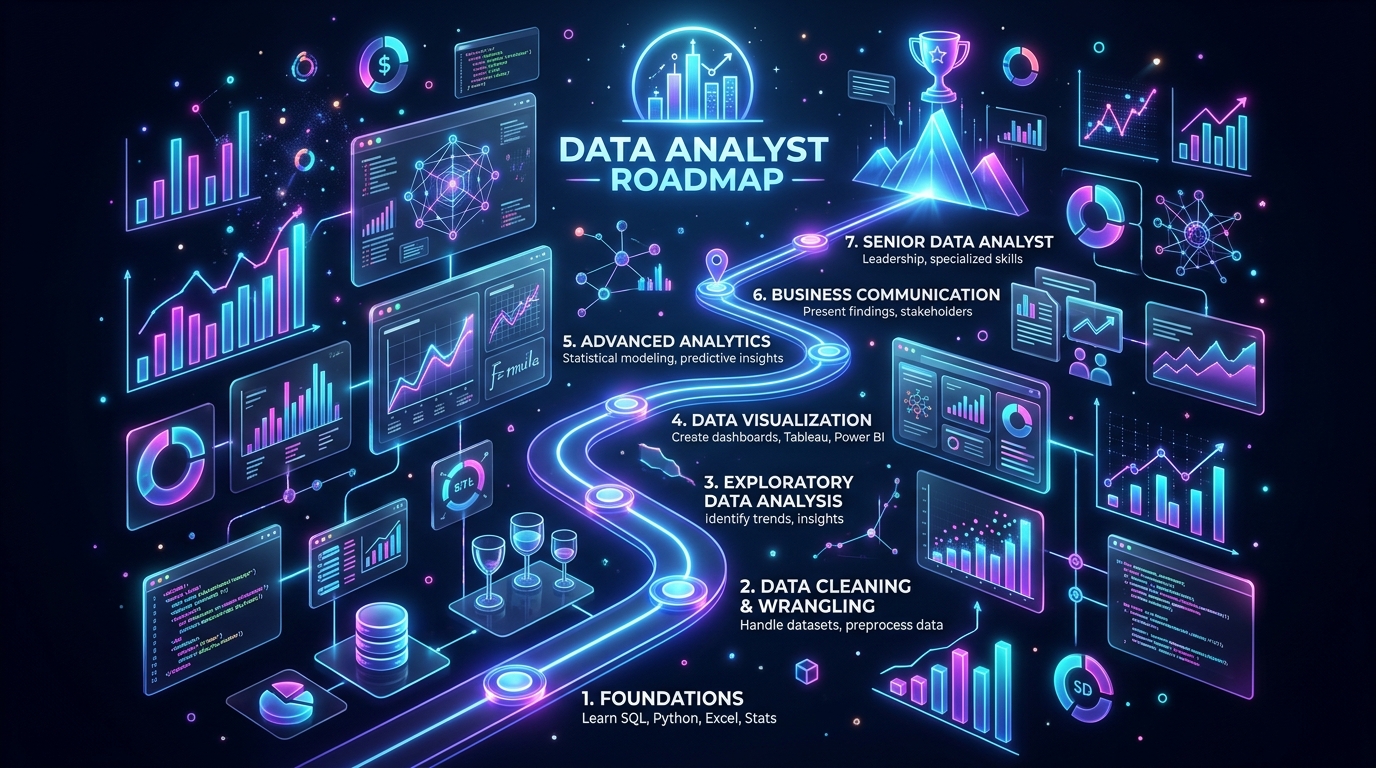
Complete job-ready career roadmap for Data Analysts. From Excel and SQL to Business Analytics and Data Storytelling.
Frequently Asked Questions
Everything you need to know about this career path.
The 7 critical steps of data analysis are: 1) Defining the Business Problem, 2) Data Collection, 3) Data Cleaning and Wrangling, 4) Exploratory Data Analysis (EDA), 5) Data Modeling & Statistical Analysis, 6) Data Visualization, and 7) Communicating Insights. Following this structured roadmap is essential whether you are a beginner or looking for a data analyst roadmap for freshers.
The absolute top 3 skills required for a data analyst are SQL (for extracting data from databases), Excel (for quick data manipulation and pivot tables), and a Data Visualization tool like Power BI or Tableau. Mastering these three forms the perfect foundation for any data analyst roadmap for beginners.
If you study intensely (4-6 hours a day) and strictly follow a structured data analyst roadmap, it is possible to learn the core tools (Excel, SQL, Power BI) in 3 months. However, to truly become job-ready, build a portfolio, and confidently pass interviews, a realistic timeline for most freshers or people pivoting careers after 12th is 6 to 8 months.
No, AI is not replacing data analysts—it is empowering them! While AI tools can help write SQL queries or generate basic charts, they cannot replace the human critical thinking required to understand complex business problems, interpret nuance in messy data, or effectively present storytelling insights to stakeholders. Analysts who learn to use AI will simply replace those who don't.
Absolutely. As long as businesses generate data, they will need analysts to make sense of it. The demand for data-driven decision-making is exploding across all industries (finance, healthcare, e-commerce, tech). It is considered one of the most stable, high-growth, and future-proof career paths you can choose.
While salaries vary heavily by location and company, an entry-level Data Analyst can expect a highly competitive starting salary compared to other non-developer IT roles. As you build a strong portfolio and transition into intermediate or senior roles (or specialize in Business Intelligence or Data Engineering), the salary potential grows exponentially.
The secret to getting a job as a fresher with no experience is building a stellar portfolio. You must show, not just tell. Complete end-to-end projects: scrape or download messy data, clean it in Excel or Python, analyze it using SQL, and build a beautiful interactive dashboard in Power BI. Host your code on GitHub and share your dashboards online—this acts as your 'experience' during interviews.
To land your very first job, Excel and SQL are usually enough. However, learning Python (specifically libraries like Pandas, NumPy, and Matplotlib) is highly recommended as you progress. Python allows you to handle massive datasets that crash Excel, automate repetitive cleaning tasks, and perform advanced statistical analysis.
While a degree in Computer Science, Math, or Statistics is helpful, it is completely optional. The primary qualifications companies look for are technical skills (SQL, Excel, BI tools) and problem-solving abilities. A strong portfolio showcasing real data projects is often more valuable than a formal degree.
Yes! Data Analysis is one of the most accessible tech careers to self-teach. Because tools like Excel and Power BI are heavily visual, and SQL reads almost like plain English, you do not need to be a hardcore programmer to get started. By following this roadmap, you can successfully teach yourself.
Data Analysis sits at the intersection of IT and Business. While it requires technical IT skills (like writing code and managing databases), the ultimate goal is to solve business problems (like increasing sales or reducing costs). You will often work closely with both the engineering team and business stakeholders.
A Data Engineer builds the 'pipes' (pipelines, databases, servers) to collect and store raw data reliably. A Data Analyst takes that stored data, cleans it, analyzes it, and creates visual reports to answer business questions. Data Engineering requires much deeper software engineering and programming knowledge.
A Business Analyst focuses heavily on processes, requirements, and communication with stakeholders, often using minimal technical tools. A Data Analyst focuses heavily on data manipulation, using technical tools like SQL and Python to find trends. However, the lines often blur in smaller companies.